


Last week, a16z wrote that you need a new CFO. Finance teams are building the tools they need, and CFOs are at the helm as architects of this new operating system.
One of our customers built an agent on Lumera that automates benefit reconciliations. It reconciles carrier invoices and payroll deductions, and generates an audit report in ~60 seconds that automatically matches the data by employee ID and flags variances. This tool replaced hours of spreadsheet work each month, and they were able to run this across their portfolio of clients.
We are seeing our users automate stock-comp journal entries, bank deposits matching, treasury reporting, close activities, A/R management, and so much more.
Our Day 1 thesis at Lumera is that AI models will keep becoming more capable, and it will be easier to build custom agents and apps than it will be to buy something off the shelf.
Last week, I gave Claude Opus 5.5 a close checklist and prompted:
I want you to study this close checklist -- my goal is to automate as much of this work end-to-end as possible. I want you to organize these tasks into Lumera projects, and propose how we should architect these projects end-to-end, with AI agents + automations / functions + human review working together
I came back a few hours later, and found that ten projects had been deployed to my Lumera account. The coding agent organized my checklist into different work streams, created a shared data layer and a close command center to manage all this from.
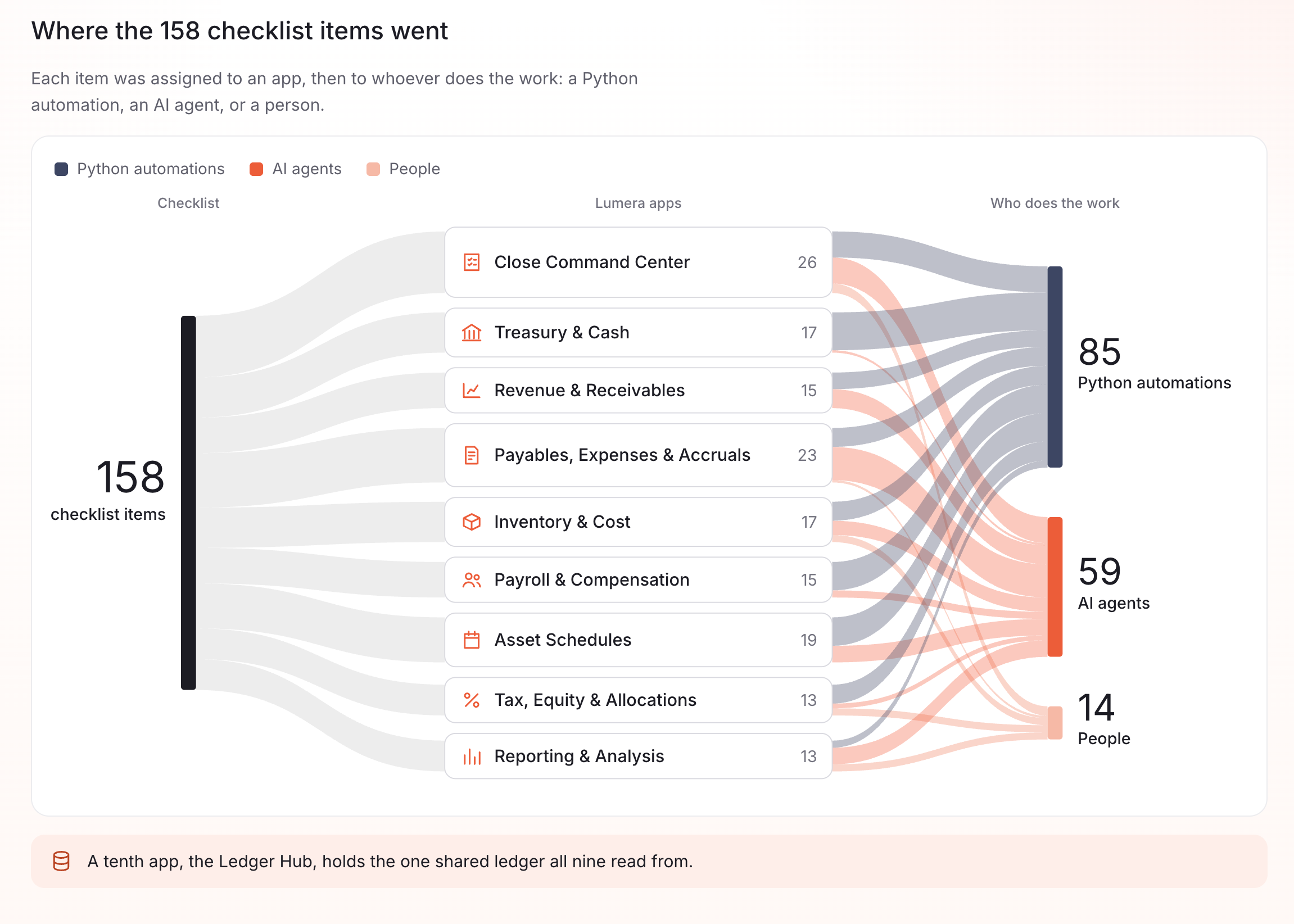
It took me some time to really process what had just happened. Here I was, looking at a full set of sub-ledger apps with clean APIs to the data layer and the close management tool.
In my years of being in Controllership at various companies, orchestrating an efficient close meant that we bought some combination of close management software, a recon / transaction matching tool, plus something for AP, something for revenue, something for fixed assets etc. Each with its own implementation, its own data model, and its own idea of how close should work.
We’re finally at a moment where AI models + the right harness + the right deployment platform can work real magic. We took the LLM, and gave it the components below to make this vision come to life.
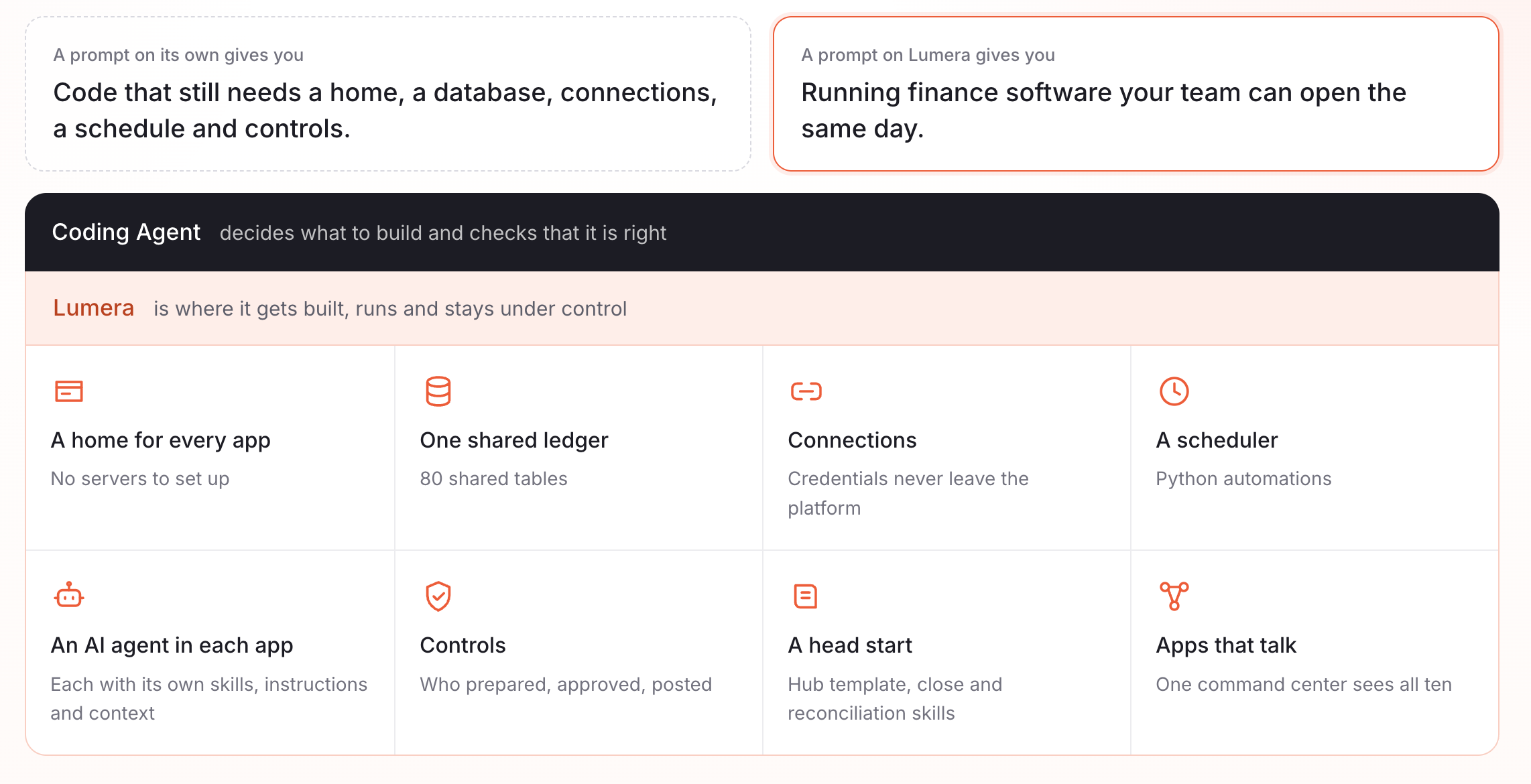
Lumera is an AI platform optimized for finance. When you build on Lumera, you get the job done better and faster because it already understands the business context, data, systems, workflows, controls and knowledge that lives in your org.
Why not just use Claude or ChatGPT?
These coding agents are great at writing code, but they are not where your controls live. Every app or agent that you build needs to get security, access controls, change management and auditability right.
For example,
Securing the application: are you sure that unsigned users won’t be able to sign into the app you vibecoded?
Role-based access: how do you make sure the right people see the right data?
Securing the APIs: are you sure that unsigned users can’t call an API which AI left unsecured
Securing the database: are you sure you changed the database username/password from the default?
Securing your keys: are you sure you don’t have an API which exposes your database credentials?
You could prompt your way to one secure app and deploy it on Vercel or Lovable. Doing it for every app, keeping each one secure as it changes, and proving all of it to your auditors every year is a different job entirely.
Lumera solves this for you by enforcing all of these controls once, at the foundation. Every agent you build inherits authentication, role-based access, change management and logging, all covered by Lumera’s SOC 1 and SOC 2 reports.
Our mission at Lumera is to give you the plumbing and control environment for building, so you can build solutions for the problem you’re trying to solve.
Build your contract review agents without worrying about accidentally exposing sensitive deal data.
Build a Slackbot to ping you when you need to negotiate vendor renewals.
Build automated month-end close reports so your team can focus on pushing the business forward.
Build anything.